What Is Gross Profit Margin? A Plain-English Guide for Small Business Owners
Gross profit margin shows how much of every sale you keep. Learn the formula, see real examples, and find out what a good margin looks like for your business.
Dennis Muchemi
4/9/202611 min read

Introduction
Most small business owners know their revenue. They can tell you what came in last month, which week was the strongest, and roughly how the quarter is tracking. But ask them how much of that revenue they actually kept after paying for what they sold, and the answer gets fuzzy fast.
That gap is where a lot of businesses quietly bleed. Not because they are doing something dramatically wrong, but because they are managing their business by the wrong number. Revenue tells you how much you sold. Gross profit margin tells you whether those sales are actually worth making.
If you have never calculated your gross profit margin, or you have heard the term but never been fully sure what it means in practice, this guide is for you. By the end, you will know exactly what gross profit margin is, how to calculate it in a few minutes using your own numbers, what a healthy margin looks like for your type of business, and what to do if yours is lower than it should be. No accounting background required.
What Is Gross Profit Margin?
Gross profit margin is the percentage of your revenue that remains after subtracting the direct costs of producing or delivering what you sell. It tells you how efficiently your business turns sales into profit before your other business expenses are accounted for.
Think of it as the breathing room your sales create. Every time you make a sale, some of that money immediately goes back out to cover what it cost you to deliver that sale. What is left after that is your gross profit. The margin is simply that leftover amount expressed as a percentage of your total revenue.
Why Gross Profit Margin Matters More Than Revenue
Revenue is the number most business owners watch. It is visible, it feels good when it grows, and it is the easiest figure to pull from your bank account or sales report. The problem is that revenue on its own tells you almost nothing about whether your business is actually financially healthy.
Here is a simple example. Imagine two small businesses, both generating $10,000 in revenue last month.
Business A spends $4,000 delivering its products or services. It keeps $6,000 as gross profit. That is a 60% gross profit margin.
Business B spends $8,500 delivering its products or services. It keeps $1,500 as gross profit. That is a 15% gross profit margin.
Same revenue. Completely different financial reality. Business B now has only $1,500 left to cover rent, salaries, software subscriptions, marketing, and everything else. One difficult month could wipe it out entirely. Business A has genuine room to breathe.
This is why gross profit margin matters. It is the first honest look at whether your business model is working, before the full picture of overheads comes into view.
The Gross Profit Margin Formula
There are two calculations involved, and you do them in order.
Step 1: Calculate your gross profit
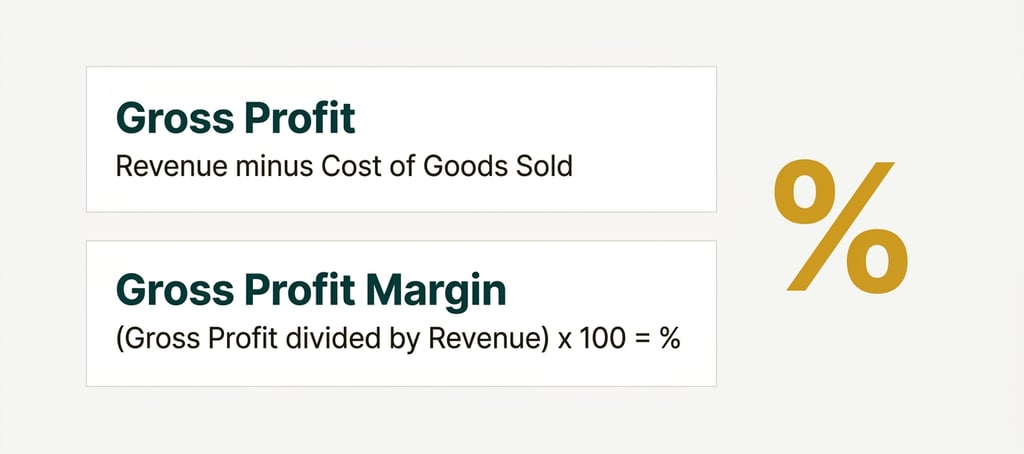
Gross Profit = Revenue minus Cost of Goods Sold (COGS)
In the UK, Australia, and some other markets, "cost of goods sold" is often called "cost of sales." The terms mean the same thing: the direct costs that go into producing or delivering whatever you sell. More on exactly what counts as COGS in a moment.
Step 2: Calculate your gross profit margin
Gross Profit Margin = (Gross Profit divided by Revenue) multiplied by 100
This gives you a percentage. That percentage is your gross profit margin.
A worked example for a product-based business:
Sarah runs a small skincare business. Last month she generated $8,000 in revenue. The cost of her ingredients, packaging, and product labels came to $2,800.
Gross Profit = $8,000 minus $2,800 = $5,200
Gross Profit Margin = ($5,200 divided by $8,000) multiplied by 100 = 65%
Sarah keeps 65 cents of every dollar in sales before her overheads are factored in.
A worked example for a service-based business:
James runs a small web design studio. Last month he invoiced $6,000 in client work. His direct costs, including a freelance developer he brought in for one project and a software licence specific to that work, came to $1,500.
Gross Profit = $6,000 minus $1,500 = $4,500
Gross Profit Margin = ($4,500 divided by $6,000) multiplied by 100 = 75%
The formula works the same way regardless of whether you sell physical products or services. The key is making sure you are using the right costs in your calculation, which leads to the next section.
What Counts as Cost of Goods Sold (And What Does Not)
This is where most small business owners make errors in their calculation, so it is worth being specific.
What belongs in COGS:
Raw materials and ingredients used to make your product
Finished goods purchased for resale
Direct labour costs: wages paid to staff who are directly involved in producing or delivering your product or service
Packaging materials
Freight and shipping costs on goods you purchase for resale
Costs directly tied to fulfilling a specific client project (subcontractors, job-specific software licences, materials)
What does not belong in COGS:
Rent and utilities (these are overhead costs)
Your own salary if you are the business owner and not directly billing labour to a specific job
Marketing and advertising spend
Accounting or legal fees
General software subscriptions like your email platform or project management tool
Bank fees and loan repayments
Including overhead costs in your COGS calculation will make your gross profit margin look worse than it actually is. It will also make it harder to diagnose where the real problem is if your margins are thin. Keep these categories clean and separate.
Curious how your business scores across all five financial health areas? Take the free MoneyKoneKt Business Finance Health Check, 20 questions, 10 minutes, complete clarity.
Step-by-Step: How to Calculate Your Gross Profit Margin Right Now
You do not need accounting software to do this. A spreadsheet or even a piece of paper will do for a first calculation.
Step 1: Find your total revenue for the period
Pick a period, last month, last quarter, or last financial year. Pull your total revenue for that period from your sales records, invoices, or bank statements. This is your starting number.
Step 2: Add up your cost of goods sold
Using the definition above, total all the direct costs that went into delivering your sales during that same period. If you are doing this for the first time and your records are not perfectly organised, do your best with what you have. An approximate figure is more useful than no figure at all.
Step 3: Subtract COGS from revenue
Revenue minus COGS = Gross Profit. Write this number down.
Step 4: Divide and multiply
Divide your gross profit by your total revenue. Multiply the result by 100. The number you get is your gross profit margin percentage.
Step 5: Write it down and track it
A single month's margin is a data point. Three months of margin figures is a trend. Six months tells you whether your business model is improving or drifting. The real value of this calculation comes from tracking it consistently, not just calculating it once.
If you use accounting software like Xero, QuickBooks, or Wave, your gross profit is usually already calculated in your profit and loss report. The margin percentage is simply the gross profit line divided by the revenue line, multiplied by 100.
What Is a Good Gross Profit Margin for a Small Business?
This is one of the most common questions small business owners ask once they have calculated their margin for the first time, and the honest answer is that it depends significantly on your industry.
Here are general benchmarks that apply broadly across the US, UK, Canada, Australia, and New Zealand markets, though local cost structures will cause some variation:
Business TypeTypical Gross Profit MarginRetail (product-based)20% to 50%Food and beverage60% to 70% (before overhead costs)Service-based businesses50% to 80%Digital products and software70% to 90%Manufacturing25% to 40%Trades and construction20% to 35%Consulting and professional services60% to 80%
A few important notes on how to read these benchmarks:
First, these are ranges, not targets. A retail business at 30% gross margin is not failing. It may be running a perfectly healthy operation if its overhead costs are well controlled and its net profit is solid.
Second, margins vary significantly within industries. A luxury retailer will typically carry higher margins than a discount retailer. A specialist consultant will often command higher margins than a generalist one.
Third, the more important question is not whether your margin hits a benchmark but whether it is improving over time and whether it is high enough to cover your overheads and still leave you with a positive net profit. A margin that looked fine twelve months ago may now be under pressure from rising supplier costs without you having noticed.
If your margin is significantly below the range for your industry, that is worth investigating. If it is within or above the range, your focus should shift to what is happening after gross profit, which brings us to the next section.
Gross Profit Margin vs Net Profit Margin (And Why You Need Both)
Gross profit margin and net profit margin measure two different things, and you need both to have a complete picture of your business finances.
Gross profit margin shows you how profitable your sales are before your general business costs are factored in. It measures the efficiency of your core business activity, the making and selling of your product or service.
Net profit margin shows you how profitable your business is overall, after every cost has been deducted, including overheads like rent, salaries, insurance, subscriptions, interest on loans, and tax. It is the final answer to the question: "Did the business actually make money?"
The formula for net profit margin works the same way:
Net Profit Margin = (Net Profit divided by Revenue) multiplied by 100
Here is why the difference matters in practice.
A business can have a healthy gross profit margin and a poor net profit margin. This happens when overheads are too high relative to revenue. The business is delivering its product or service efficiently, but the cost of running the operation is eating through the gross profit before anything is left over.
Example: A small marketing agency generates $15,000 in monthly revenue. Its direct delivery costs (freelancers, ad spend for clients) come to $5,000, giving a gross profit of $10,000 and a gross margin of 67%. Healthy. But rent, salaries, software, and other overheads total $9,500. That leaves a net profit of $500 and a net profit margin of just 3.3%.
The gross margin looked fine. The net margin reveals the real problem: overheads are too high for the revenue level.
This is why looking at gross margin in isolation is not enough. It is the right place to start, but your P&L statement tells the full story. You can find a detailed walkthrough of how to read a profit and loss statement in [Post 9 - internal link placeholder].
A brief note on operating profit margin:
Operating profit margin sits between gross and net. It accounts for COGS and operating expenses (like rent, salaries, and utilities) but excludes interest and tax. It is a useful measure for comparing operational efficiency across businesses or periods, and your accounting software will typically show it in your P&L report.
What to Do If Your Gross Profit Margin Is Too Low
If your margin is coming in below the typical range for your industry, or if it is declining month on month, there are four main levers you can work with.
1. Review your pricing
This is the most direct lever and also the one business owners are most reluctant to pull. If your costs have risen over the past year but your prices have not moved, your margin has been silently shrinking. Recalculate what it actually costs you to deliver your product or service today, not what it cost eighteen months ago, and price from that current reality.
Underpricing is one of the most common reasons small business margins are thin. You do not always need a large price increase. Even a 5% to 10% adjustment on your core offering can meaningfully shift your margin.
2. Reduce your cost of goods sold
Look at your direct costs line by line. Are there supplier agreements that have not been reviewed recently? Are there materials or inputs with more cost-effective alternatives that would not compromise quality? Is there waste in your production or delivery process that is adding to costs without adding value?
Even small reductions in COGS compound significantly at scale. A $200 monthly reduction in direct costs is $2,400 a year back into your margin.
3. Shift your product or service mix
Not everything you sell has the same margin. Some products or services are significantly more profitable than others, and many business owners do not know which are which because they have never calculated margin by product line.
If you can identify your highest-margin offerings and actively sell more of those while reducing time and resources spent on low-margin work, your overall gross margin will improve without you needing to change your prices or cut your costs.
4. Audit what you are including in COGS
As mentioned earlier, incorrectly including overhead costs in your COGS will artificially deflate your gross margin. If your margin seems surprisingly low, check your categorisation before assuming there is a pricing or cost problem. Sometimes the fix is in the accounting, not the business model.
A Common Mistake: Confusing Gross Profit and Gross Profit Margin
These two terms are related but they are not the same thing, and mixing them up leads to poor decisions.
Gross profit is a currency amount. It is the actual money left after subtracting COGS from revenue. In the earlier example, Sarah's gross profit was $5,200.
Gross profit margin is a percentage. It expresses that profit as a proportion of revenue. Sarah's gross profit margin was 65%.
Why does the distinction matter? Because the currency amount alone does not tell you much without context. A business with $50,000 in gross profit sounds healthier than one with $5,200 in gross profit. But if the first business generated $400,000 in revenue to get there, its gross margin is only 12.5%. The second business generated $8,000 in revenue, giving it a 65% margin. On a per-dollar-of-sales basis, the smaller business is far more efficient.
Always use the percentage when comparing performance across periods, across products, or against industry benchmarks. Use the currency amount when making decisions about cash flow and overheads.

Frequently asked questions
What is a good gross profit margin for a small business?
It depends on your industry. Service businesses typically operate between 50% and 80%. Retail businesses between 20% and 50%. Food and beverage businesses between 60% and 70% before overheads. The more important question is whether your margin is sufficient to cover your overheads and leave a positive net profit, and whether it is stable or improving over time.
What is the difference between gross profit and net profit?
Gross profit is what remains after subtracting the direct costs of producing or delivering your product or service. Net profit is what remains after all costs are deducted, including overheads like rent, salaries, subscriptions, interest, and tax. Gross profit tells you how efficient your sales are. Net profit tells you whether the overall business is making money.
How do I improve my gross profit margin?
The four main options are: increase your prices, reduce your direct production or delivery costs, sell more of your highest-margin products or services, and make sure your COGS calculation is accurate and not inflated by costs that belong in your overheads.
Is gross profit margin the same as markup?
No, though they are related. Markup is the percentage you add to your cost to arrive at your selling price. Margin is the percentage of the selling price that is profit. A product that costs $50 and sells for $100 has a 100% markup but a 50% gross margin. Margin is always a lower percentage than markup for the same product.
What does a low gross profit margin tell me about my business?
A low margin relative to your industry typically signals one of three things: your prices are too low relative to your costs, your direct costs are too high relative to your prices, or your product or service mix is weighted towards low-margin work. It is worth investigating all three before drawing conclusions.
Conclusion
Gross profit margin is one of the most important numbers in your business, and one of the most underused by small business owners who are focused on revenue alone.
Calculating it is straightforward. Understanding what it means for your specific business takes a little more context, but the benchmarks and signals in this guide give you a solid starting point. The goal is not to hit a benchmark. The goal is to know your number, understand what is driving it, and track it consistently enough to catch problems before they become expensive.
Start with last month's figures. Run the calculation. Write the number down. Then run it again next month and the month after. That simple habit will tell you more about the health of your business than almost any other single metric.
Reading about gross profit margin is one thing. Knowing exactly where your business stands across all five financial health areas is another.
The MoneyKoneKt Business Finance Health Check walks you through 20 questions covering cash flow, bookkeeping, profitability, tax, and financial visibility. It takes 10 minutes, it is written in plain English, and it gives you a score with clear next steps on where to focus first.
It is free. And it is the fastest way to go from "I think I should sort my finances" to "I know exactly where to start."